Siemens Water Portal

Online assistance for design and configuration of water and waste water systems

Please use another Browser

It looks like you are using a browser that is not fully supported. Please note that there might be constraints on site display and usability. For the best experience we suggest that you download the newest version of a supported browser:

Internet Explorer, Chrome Browser, Firefox Browser, Safari Browser

Continue with the current browser

Please use another Browser

It looks like you are using a browser that is not fully supported. Please note that there might be constraints on site display and usability. For the best experience we suggest that you download the newest version of a supported browser:

Internet Explorer, Chrome Browser, Firefox Browser, Safari Browser

Continue with the current browser

Customized planning and engineering support for your system

The configuration of power distribution and automation elements when designing water and wastewater systems, pump stations, and desalination plants determine their reliability, cost efficiency, and performance. To give consultant engineers and planners the best possible assistance with this task, Siemens has developed an efficient tool for your day-to-day work: the Siemens Water Portal. The portal contains all information relevant to the planning process in terms of electrotechnical equipment, along with practical examples for configuring the automation and power distribution.
With the Industry Online Support  you have access to more than 300,000 documents about Siemens Industry products.
SIOS


What's New?

We constantly work on improving and expanding the Water Portal to offer our best support to you. To make the updates more visible we will post our latest and upcoming changes below.

June 2025

In this version of the WWTP-M application example, the main change is the transition from the previous PCS 7- based process control system to a WinCC OA based solution. Because of this shift, the automation concept was not updated partially, it was redesigned almost from scratch to ensure consistency and compatibility across all planning and engineering aspects.
The following changes were made:
  • New process control system: WinCC OA: The previous PCS 7-based setup was replaced. A dedicated WinCC OA project file is now included, containing relevant components for visualization and control
  • Redesign of the automation and technological planning: The redesign was carried out both in the technological planning (Visio files) and in the automation layer (also in Visio and the TIA Selection Tool), aligning all parts with the new system architecture
  • Optional digestion: The process structure now includes an optional digestion stage, offering more flexibility in how the configuration is used.
  • Updated documentation and structure: All planning documents were revised to reflect the new concept and structure
  • New chapters added:
    Additional chapters have been added to this version for:
    - Energy Manager Pro
    - SINEC Family
    - SINEC NMS
    - UMC

October 2024

This time, significant improvements have been made for the “Wastewater Treatment Plant small”-application example (= WWTP-S). The main goal was to improve the digitalization of the Bill of Material (BoM) using the TIA Selection tool and the SiePortal / Industry Mall platform, making it easier to engineer and configure the system components.
For the application example Wastewater Treatment Plant small (WWTP-S) we did the following changes (among others):
  • Update of the automation design with WinCC Unified (instead of WinCC V8).
  • Upgrade of components like:
    - replacing 3G communication by 4G & 5G
    - Substitute RTU 3031 with RTU3051 in Visio and BoM
    - Use of 5G technology with SCALANCE MUM853-1 to connect Remote I/O directly to the CPU. 
    - Profibus Communication with the communication module CN4100
    - Replacement of PROFIBUS DP by Profinet in many sections. 
  • New chapters were added for EnergyManager Pro, SIMATIC eaSie, Industrial Automation Data Center, SINEC Family, SINEC NMS, and UMC.
  • The TIA Selection tool file contains configurations for the control components (not: instrumentation and drives).
  • The whole Bill of Material is available in Excel and the automation part without instrumentation and drives is available in TIA Selection tool.
The commitment remains to continuously improve and expand the Water Portal to better support users.

March 2024

This time, significant improvements have been made in the Water Portal, with a focus on major updates to the Wastewater Treatment Plant large (= WWTP-L). The main goal was to improve the digitalization of the Bill of Materials (BoM) using tools like the TIA Selection tool, CDT tool, SIMARIS and the SiePortal / Industry Mall platform, making it easier to engineer and configure the system components. These digitalized BoMs will also be adopted for the other water applications (next releases).
In all application examples we have updated the links in the Visio-documents. 
For the application example Wastewater Treatment Plant large (WWTP-L) we did the following changes (among others):
  • Update of the automation design including the addition of a new CPU S7 410 5H (AS5) in the External Pump Station section.
  • Upgrade of components like:
    - replacing 3G communication by 4G & 5G
    - Substitute RTU 3031 with RTU 3041 and soon with RTU3051 (release in March 2024) in Visio and BoM
    - adopting XR326-8 instead of SCALANCE X/XR
    - Use of 5G technology with SCALANCE MUM853-1 to connect Remote I/O directly to the CPU.
    - ModBus Communication with the communication module CN4100
    - Replacement of PROFIBUS DP by Profinet in many sections. 
  • An example for remote I/O in Ex-zones was added for the Gas Reservoir in the sludge digestion section, focusing on explosion protection.
  • Links for SIMOCODE pro V, Motor Branch with SIRIUS, and the Contactor 3RT for switching Motors have been updated with the current product versions.
  • New chapters were added for SIMATIC EnergyManager Pro, SIMATIC eaSie, Industrial Automation Data Center, COMOS PAA (Process Automation Accelerator), Standardization of Water Templates, SINEC Family, SINEC NMS, and UMC.
  • The TIA Selection tool file contains configurations for the control components (not: instrumentation and drives)
  • The CDT Tool contains all components (except drives) and allows to generate new BoMs after modifications.
  • The Drive components are available in an extra BoM but will also be implemented in the Control Panel Designer (CPD) in one of the next releases.
  • The Bill of Material has been generated directly in the Control and Design Tool (CDT) containing all automation, communication and instrumentation components and has been included in the zip packages replacing the old Excel files.
The commitment remains to continuously improve and expand the Water Portal to better support users.

Sample Configurations

Desalinate Seawater – Preserve Life

As a planner and operator, the most important aspects of seawater desalination are improving security of supply, reducing energy requirements, and ensuring the highest level of water treatment control. Due to the complex nature of the plants, state-of-the-art control and monitoring systems are indispensable. After all, the process not only uses a great deal of energy, it is also expensive.
We offer a wide range of application examples to further improve the efficiency of your system configuration. These make all the difference when it comes to planning more quickly, efficiently, and reliably – and you will benefit from maximum transparency at all times to allow you to make an informed decision regarding product selection.
Here you will find a scalable automation and drive technology concept based on a medium seawater desalination plant supplying 14,000 m³/day. When it comes to the specific configuration of your station, we support you with our extensive portfolio of products, services, and templates for SIMATIC PCS 7 – from design to operation and maintenance. 
Desalination Medium (14,000 m³/day - PCS 7)
Here you will find a scalable automation and drive technology concept based on a large seawater desalination plant supplying 200,000 m³/day. When it comes to the specific configuration of your station, we support you with our extensive portfolio of products, services, and templates for SIMATIC PCS 7 – from design to operation and maintenance. 
Desalination Large (200,000 m³/day - PCS 7)

Ensuring a Lasting Water Supply

In many regions of the world, groundwater is not enough to cover the need for drinking water. As a result, water treatment using surface water or even waste water become increasingly important, especially in countries that face constant water shortages or whose flowing water is heavily polluted. With our intelligent automation technology, drive technology, switch technology, and power distribution systems we support you as a planner and operator in ensuring that your plant runs smoothly and that drinking water treatment can continue day after day.
We have many different application examples to help make your system configuration even more efficient. They make all the difference when it comes to planning more quickly, efficiently, and reliably – and you will benefit from maximum transparency at all times to ensure a reliable product selection.
Typical configurations for water utilities are classified according to the daily throughput volume. Medium-sized facilities with a volume of about 5,000 cubic meters per day are best suited to smaller communities and towns. When configuring your water utility, we provide an extensive portfolio of products, services, and templates that cover all stages, from design to operation and maintenance.
Water Treatment Medium (5,000 m³/day - WinCC)
Typical configurations for water treatment plants are classified according to the daily throughput volume. Large facilities with a volume of about 120,000 to 150,000 cubic meters per day are best suited to major metropolitan areas. When configuring your water treatment plant, we provide an extensive portfolio of products, services, and templates that cover all stages, from design to operation and maintenance.
Water Treatment Large (150,000 m³/day - PCS 7)

Operating Water Supply Stations Efficiently
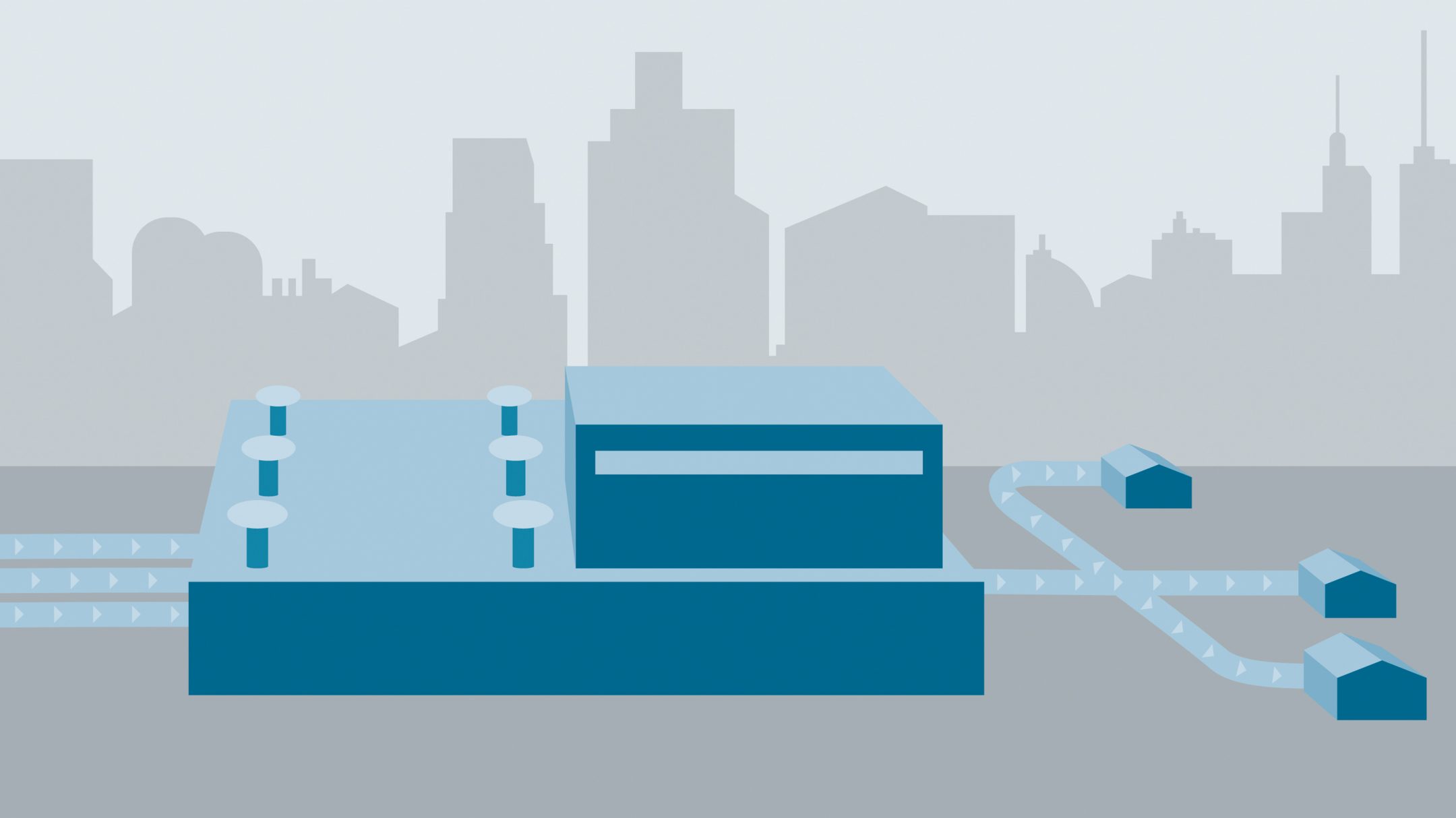
Pump stations play an extremely important role in the water supply. They convey water and feed it into the drinking water supply network. Because the pump stations and treatment plants are frequently separated by large distances, they are often unmanned. With our comprehensive portfolio, we support you as a system planner, equipment supplier, and plant operator by means of end-to-end engineering as well as consistent and reliable process management, both for central and remote sub-plants. For the latter we offer secure integration via telecontrol technology, with central as well as on-site or emergency operating level, and we thus ensure availability and security of supply.
We have many different application examples to help make your system configuration even more efficient. They make all the difference when it comes to planning more quickly, efficiently, and reliably – and you will benefit from maximum transparency at all times to ensure a reliable product selection.
Here you will find a scalable automation and drive technology concept based on the example of a very large water pump station. When it comes to the concrete configuration of your station, we support you with an extensive portfolio of products, services, and templates, from design to operation and maintenance.
Water Pump Station Very Large (360,000 m³/day - PCS 7)

Operating Wastewater Pump Stations Efficiently
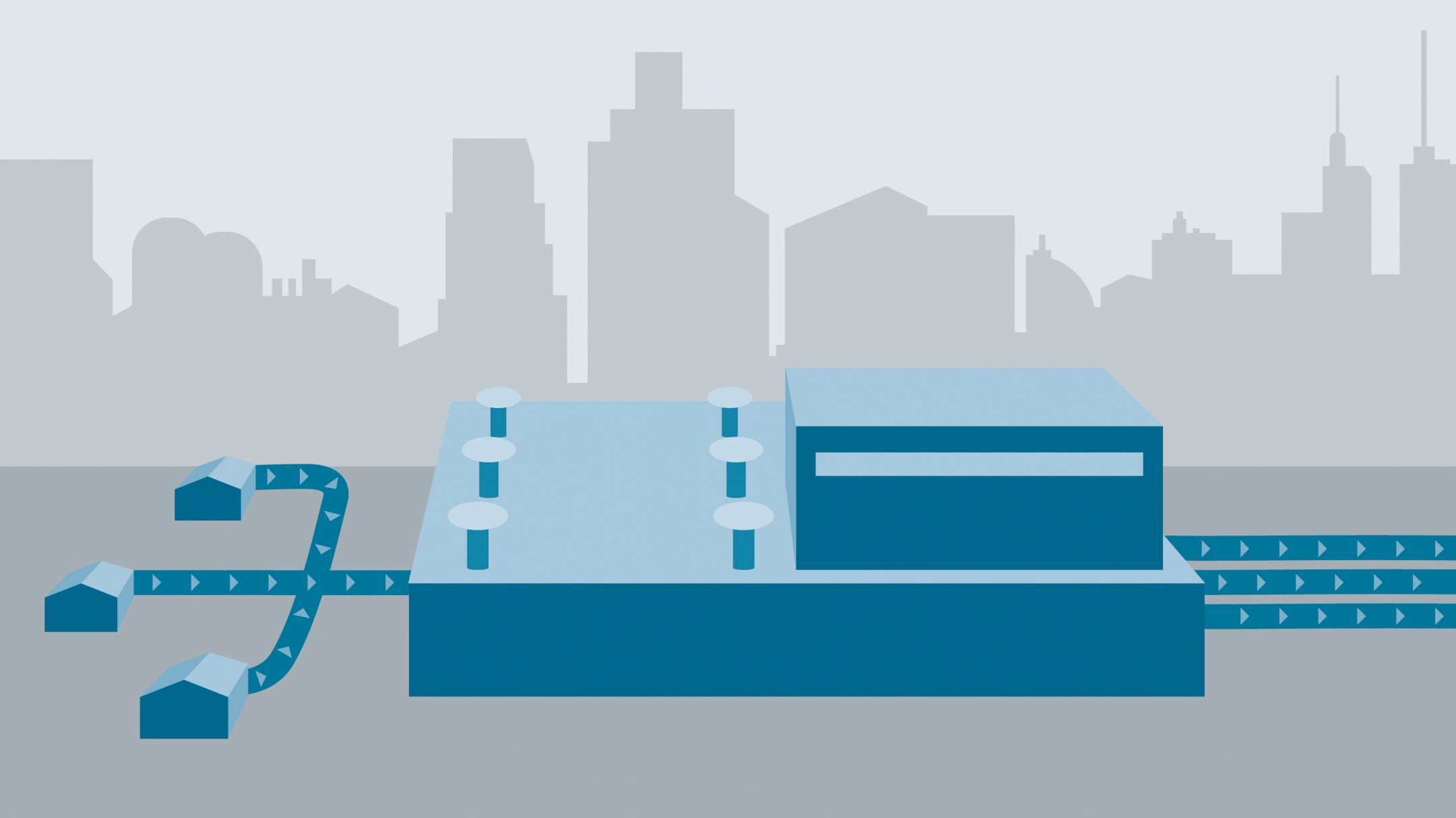
Pump stations play an extremely important role in the disposal of water. They pump waste water to treatment plants via the wastewater network. Because the pump stations and treatment plants are frequently separated by large distances, they are often unmanned. With our comprehensive portfolio, we support you as a system planner, equipment supplier, and plant operator by means of end-to-end engineering as well as consistent and reliable process management, both for central and remote sub-plants. For the latter we offer secure integration via telecontrol technology, with central as well as on-site or emergency operating level. Preconfigured automation solutions are available especially for the transport of wastewater; these solutions independently detect and correct issues such as incipient pump blockages.
We have many different application examples to help make your system configuration even more efficient. They make all the difference when it comes to planning more quickly, efficiently, and reliably – and you will benefit from maximum transparency at all times to ensure a reliable product selection.
Here you will find a scalable automation and drive technology concept based on the example of a very large wastewater pump station. When it comes to the specific configuration of your station, we support you with an extensive portfolio of products, services, and templates, from design to operation and maintenance.
Wastewater Pump Station Very Large (575,000 m³/day - WinCC)

Efficient and Reliable Wastewater Treatment

Wastewater from households and industry contains varying levels of contamination, which may be chemical, biological, or with solid matter. That makes reprocessing of wastewater extremely costly. As a planner and operator, you face the challenge of designing and operating your plant economically and ensuring that it will remain viable into the future. We are happy to support you with our comprehensive portfolio and individual solutions.
We have many different application examples to help make your system configuration even more efficient. They make all the difference when it comes to planning more quickly, efficiently, and reliably – and you will benefit from maximum transparency at all times to ensure a reliable product selection.
Typical configurations for small wastewater treatment plants are divided into three main classes, depending on population size: size category 1 (less than 1,000 inhabitants), 2 (1,000-5,000 inhabitants), and 3 (5,000-10,000 inhabitants). When configuring your wastewater treatment plant, we support you with an extensive portfolio of products, services, and templates that cover all stages, from design to operation and maintenance.
Wastewater Treatment Small (5,000 m³/day - WinCC_Unified)
Medium-sized wastewater treatment plants are used mainly in cities and communities of up to 100,000 inhabitants. These are divided into two size categories: 4a for 10,000 to 50,000 inhabitants and 4b for populations greater than 50,000. When configuring your treatment plant, we support you with an extensive portfolio of products, services, and templates, from design to operation and maintenance.
Wastewater Treatment Medium (8,000 m³/day - WinCC OA)
Very soon, two-thirds of the world’s population will live in cities – many in major metropolitan areas. Facilities in size category 5, which treat wastewater from more than 100,000 inhabitants, are subject to special requirements. When configuring your treatment plant, we support you with an extensive portfolio of products, services, and templates that cover all stages, from design to operation and maintenance.
Wastewater Treatment Large (30,000 m³/day - PCS 7)

Cybersecurity for Critical Infrastructures

In the following section we provide you with general information on cybersecurity at Siemens as well as concepts for selected products and systems.

Cybersecurity at Siemens
Protect what you value – with our holistic approach and leading technology expertise.
Charter of Trust
For a secure digital world. Cybersecurity is becoming the most important security topic of the future – particularly in the age of digitalization.
Defense in Depth
Comprehensive concept for plant and network security as well as and system integrity according to IEC 62443
Cyber Security for Critical Infrastructures
White papers and technical articles including critical infrastructures, SIMATIC, Telecontrol, WinCC and PCS 7 
Current regulations and certifications based on IEC 62443
Improve security of industrial facilities through certification and standards
Cybersecurity in the water industry: Essential protection
Article on the necessity of modern cyber security systems by Siemens.
Cybersecurity for the Process Control System SIMATIC PCS 7
Compendium Part F - Industrial Security (V9.0)
Whitepaper
Cybersecurity - Defense in depth concept for the Water and Waste Water Industry
Cybersecurity for the Water Industry
Website with comprehensive information on how to protect the water industry from cyber threats

Secure Control System Architectures with SIMATIC PCS 7 and WinCC

We provide blueprints for system architectures - including a detailed Secure Configuration Guideline - for Fresh Water, Waste Water and (Reverse Osmosis) Desalination Plants. They are based on a certified architecture according to IEC 62443-4-1 / -3-3 for PCS 7 and architectures according to IEC 62443 4-1 /3-3 for WinCC OA, WinCC V7, WinCC RT Prof  taking into account further requirements such as telecontrol and distributed plants.

Configurators

Do you always need the optimum configuration for planning your project? Of course you do! For your application we offer the following tools to support all project planners, beginners and experts alike.

TIA Selection Tool
The configuration for Totally Integrated Automation
Drive Technology Configurator
Seelect between our products from entire control systems down to single motors
TIP Consultant Portal
Tool for all phases of electrical planning
PIA Life Cycle Portal
Engineering, ordering and installation for Process Instrumentation and Analytics
Concept & Design Tool (CDT)
Quick cost estimate for your PCS 7 configuration including bill of material creation.
WinCC OA configurator
Tool for simple and fast configuration of plant parts – with Industry Mall Export funtion

Tender Specifications

In order to support you with the creation of tender specifications, we provide you with a selection of tender text modules and specifications for individual products.

PCS 7 V9.1
Specification for a Process Automation System
PCS 7 V9.0
Specification for a Process Automation System
WinCC V8.1
Functional Tender Description
WinCC OA V3.20
Functional Tender Description
WinCC Unified PC RT V20
Functional Tender Description
Tender Specifications Portal
Tender and Project Documentation Support by Siemens

Application

The following documents illustrate various typical applications in the water and waste water industry. In the field of automation, process instrumentation and drive technology – as well as in combination with telecontrol technology – we offer you comprehensive concepts as well as specific solutions for efficient process management and compliance with regulatory guidelines and quality standards.

SIMATIC PLC and SCADA templates
Tailor made technological library for solutions with TIA-Portal, SCADA and HMI Panels
PCS 7 and WinCC/S7 Templates
Tailor-made Templates using WinCC/S7 for the Water Industry
PCS 7 and SIMIT Templates
Tailor-made Templates using SIMIT for the Water Industry
Plant-wide Automation
Guideline for a Smooth, Consistent and Standardized Solution
Typical Configuration in Water and Waste WaterTechnology
Description of Architectures and Components
System Solutions
Application Examples Water and Waste Water
Simocode pro V
Prevention of Pump Blockages by Changing the Direction of Rotation
Sinamics G120/G120P, CU230P-2: Pressure-Controlled Pumps
Application Description for the Scripted Commissioning
Remote Configurations in Water and Waste Water Technology
Description of Concepts and Components of the Telecontrol Technology
SIRIUS 3RW55 soft starters – Pump cleaning
Preventing reduced active power due to clogging of pump impeller
Simulation Tool for Soft Starters (STS)
In-depth simulation application for Windows, Android and iOS
PIA Life Cycle Portal
Engineering, ordering and installation for Process Instrumentation and Analytics

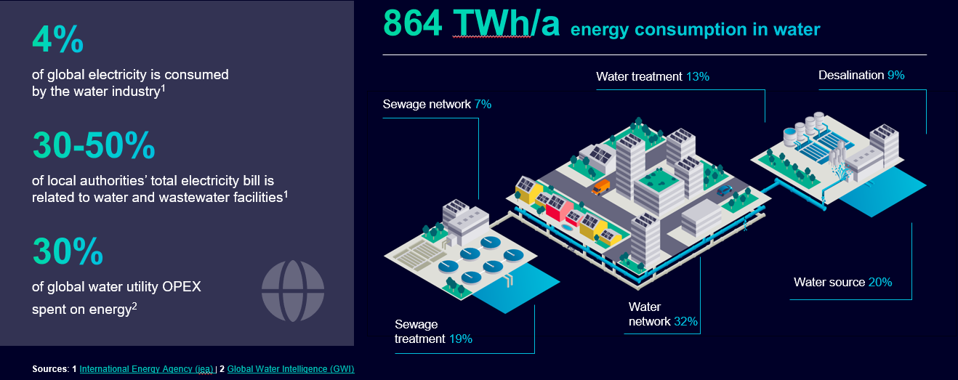
Energy efficiency and the usage of renewable energy are key levers to decarbonize the Water industry

  • Water utilities are usually regulated entities with the primary goals to protect public health and environmental integrity providing their services at reasonable rates.​
  • Energy efficiency and GHG reduction hasn’t been a primary goal yet, but growing populations, environmental needs and legislation become increasingly stringent.​
  • Designing new or expanded water facilities starts with optimizing the process as well as the hydraulic and energy systems to meet present and future demands for sustainable, resilient, and energy-neutral operations.​
The EU Urban Wastewater Directive, entered into force on January 1, 2025, requires wastewater treatment plants to evolve from energy consumers to energy-neutral operations or even energy hubs, adopting advanced technologies and resource recovery solutions: 
  1. Increasing Energy Efficiency in treatment processes to minimize energy consumption and environmental impact from Carbon dioxide in water & wastewater plants.
  2. The installation of PV Systems helps offset high electricity demand, reduces operational cost and lowers carbon footprint. PV systems can incrementally be deployed as electrical power demand increases.
  3. Biogas utilization by capturing biogas from anaerobic digestion and using it in combined heat and power (CHP) modules to generate electricity and heat
  4. Thermal energy recovery from treated wastewater enables the supply of district heating, contributing to urban decarbonization.
  5. Power-to-gas technologies further enhance sustainability by converting surplus renewable electricity and captured CO₂ into methane, which can be stored and fed into the gas grid to increase energy flexibility.

Siemens supports consultants, EPCs, and end customers in the water utility sector with a comprehensive portfolio for energy efficiency and net zero – from the design phase through to operation

Design Optimization

A highly effective strategy for minimizing energy consumption in water utilities lies in the holistic optimization of process design, hydraulic systems, and power generation. Leveraging renewable energy sources, variable speed drives, and purpose-built process packages - combined with a well-engineered hydraulic infrastructure - can deliver substantial efficiency gains. With Siemens' cutting-edge design tools, utilities can build digital twins that result in smarter process, hydraulic, and energy system optimization - unlocking maximum efficiency and performance
gPROMS significantly enhances Wastewater Treatment Plant (WWTP) design by enabling comprehensive process modeling, simulation, and optimization of various unit operations. This allows engineers to predict performance, optimize equipment sizing and operational strategies, and mitigate risks, leading to more efficient, sustainable, and robust plant designs.
Design optimization with the Digital Process Twin – gPROMS
Simcenter Flomaster supports hydraulic design by enabling comprehensive CFD simulation of entire fluid networks, including piping, pumps, and valves, for both steady-state and transient conditions. This allows engineers to predict performance, optimize component sizing, evaluate "what-if" scenarios, and mitigate risks like pressure surges, leading to more efficient, robust, and safe hydraulic systems.
Hydraulic Digital Twin Simcenter Flomaster
mm.esd supports the integration of renewable and other energy sources within wastewater treatment plants by identifying the best combination of technologies, which are available today or expected to become available in the future 
Energy Digital Twin mm.esd

Operations Optimization

Once a water plant has been constructed and operated for several years, implementing large-scale design modifications is often challenging due to the significant investment required. In such cases, Siemens' digital twin technology offers a powerful solution to enhance process efficiency and reduce energy costs without major physical changes.
gPROMS based Treatment Optimizer significantly enhances operation of wastewater treatment plants by optimizing energy-intensive aeration, minimizing chemical dosing, leading to drastic cost savings. It improves nutrient removal efficiency and optimizes sludge management for better resource recovery. „What-if" scenario simulations enable operators to directly respond to varying influent loads and disturbances, ensuring robust and resilient plant performance.
Operations optimization with the Digital Process Twin – Treatment optimizer gPROMS
The SIMIT-based Operator Training System (OTS) provides regular staff training, empowering operators to react swiftly and correctly to abnormal plant behavior. This capability, including managing overloads through load shifting or shedding, ensures smooth and stable plant operation
Keeping skills of staff at highest level – Operator training systems (OTS)
Energy Manager Pro significantly enhances energy management by centralizing the collection, analysis, and visualization of energy data across an entire plant, providing a comprehensive source of consumption data enabling operators to identify energy-saving potentials, optimize processes, and implement measures to reduce costs and improve efficiency. Ultimately, it helps meet compliance requirements, and contributes to overall sustainability goals.
Energy Management with Energy Manager Pro
SIWA Network Optimizer significantly reduces energy costs for pipeline operators by dynamically optimizing pump scheduling based on real-time water consumption and electricity tariffs, thereby minimizing overall energy cost. Through predictive control, it proactively adjusts pump operations to anticipate demand and prevent energy waste from overpumping, ensuring stable and cost-effective pipeline management.
Energy Cost reductions Pipelines & networks - Network Optimizer
SIWA Leak Finder leverages real-time hydraulic modeling and sensor data to pinpoint leak locations by identifying discrepancies between predicted and actual network behavior. By enabling rapid leak detection and intervention, it helps prevent significant pressure drops, thereby maintaining minimum required pressure levels across the water network
Network Digital Twin Pipelines & networks - SIWA Leak Finderr

Renewable Energy

Renewable energy plays a vital role in helping water utilities reduce their carbon footprint, lower operational costs, and improve sustainability. E.g., Wastewater treatment plants usually have a lot of space for solar panels and such with sludge digestion produce gas to cover around 30 to 50 % of their annual power demand. Siemens offers advanced digital software tools that enable island grid operation, facilitate the trading of surplus electricity, reduce reliance on grid-supplied power, and optimize the integrated use of heat, gas, and electricity.
The SICAM Microgrid-Controller supports wastewater treatment plants aiming for energy neutrality by intelligently integrating and managing diverse energy sources like biogas-fueled CHP units, solar panels, and energy storage systems within the plant's operational grid. By optimizing the generation and consumption of energy, coordinating with the main grid, and enabling islanding capabilities, it maximizes self-consumption of renewable energy and reduces reliance on external power.
SICAM Microgrid Controller
ELOS is an intelligent application capable of optimizing the energy supply system of sewage treatment or desalination plants, also called smart energy management and dynamically adjusting fluctuations in both energy supply and demand. ELOS uses advanced data driven technologies to optimize energy systems by integrating IoT devices, AI, and Real-Time Monitoring such, that plant operation becomes more efficient, sustainable, reliable and cost-effective.
Energy optimization to minimize electrical power from the grid - ELOS

Electrical Drives

Variable speed drives unlock substantial energy savings and operational efficiency Variable Speed Drives (VSDs) enable pumps to dynamically adjust their operating speed in response to real-time demand, rather than running continuously at full capacity. This significantly reduces energy consumption, especially during periods of low water demand. VSDs also help mitigate power surges associated with frequent start/stop cycles and can be automatically optimized using predictive analytics or real-time operational data. Additionally, their ability to adapt to fluctuating power inputs makes them ideally suited for integration with renewable energy sources.
Siemens VFDs significantly boost sustainability in wastewater treatment plants by precisely controlling motor speeds, leading to substantial energy savings (compared to fix speed motors) and optimized treatment processes for pumps and blowers. This precise control also reduces wear and tear on equipment, extending its lifespan and contributing to a more efficient and environmentally friendly operation
Variable Frequency Drives (VFD)

Industrial Services

Siemens Industrial Services support water utilities to significantly improve energy efficiency Siemens supports water and wastewater utilities in identifying inefficiencies and process bottlenecks, and in collaboratively developing a tailored roadmap of actionable improvement measures. The Siemens Industrial Services portfolio spans from comprehensive energy assessments and modernization services to advanced energy management and performance contracting—where energy savings are used to finance modernization investments, supported by Siemens Financial Services
Siemens supports water customers with energy and decarbonization assessments by leveraging deep expertise and digital tools to conduct comprehensive audits. This process identifies key opportunities for efficiency, renewable energy integration, and emissions reduction, delivering a tailored roadmap for the water plant towards energy neutrality and decarbonization
Energy & Decarbonization Assessments
Siemens offers water plant operators retrofit and modernization measures, including high-efficiency motor and VFD upgrades, and optimized pumping/blower systems, to significantly boost energy efficiency. These are complemented by advanced control and automation systems, digitalization, and energy management tools for precise process optimization and extended equipment lifespan.
Retrofit and Modernization
Siemens offers water customers comprehensive energy management services, leveraging advanced systems for tracking, analyzing, and reporting energy consumption, alongside with digitalization and analytic tools for real-time monitoring and identifying inefficiencies. These services also include integration of renewable energy sources and implementing advanced process control to optimize operations and minimize overall energy use.
Energy Management Services
Siemens provides comprehensive energy efficiency offerings, including high-efficiency motors, VFDs, and optimized control systems, designed to significantly reduce energy consumption in operations. These offerings can be delivered through performance contracting, where Siemens guarantees energy savings and finances the initial investment, with repayment tied directly to the achieved energy cost reductions.
Performance Contracting